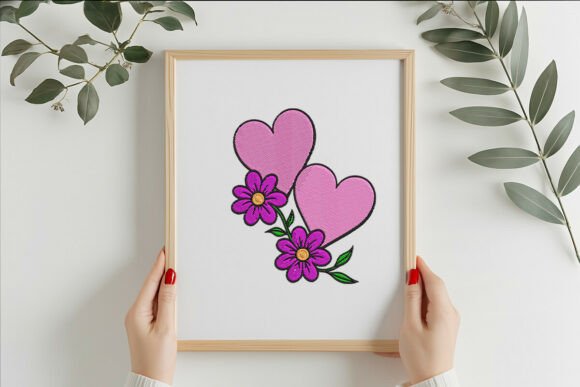
Love Flower Embroidery Design
A Line Art Love Hand That Feels Like a Whisper—Not a Shout
First impression? This isn’t a bold, floral explosion—it’s quiet intention. The Love Flower Embroidery Design leans into clean line art: two hands cradling a simple flower, with subtle heart-shaped negative space in the stem. It’s gentle, not cutesy; symbolic, not literal. As a designer who’s stitched hundreds of wedding-themed pieces—from bridal robes to monogrammed tea towels—I immediately saw its quiet strength. It doesn’t scream “love” or “wedding.” It invites pause. That makes it unusually versatile—and unusually easy to misplace if you’re not thoughtful about context.
Where It Shines: Real Projects, Real Reactions
Last week, I prepped a batch of organic cotton tote bags for a local boutique’s spring launch—each meant to hold handmade soaps and dried lavender bundles. I chose the Love Flower Embroidery Design for the lower left corner, 3.2" wide, on natural canvas. Why? Because it didn’t compete with the product inside or the shop’s minimalist branding. Customers paused, traced the shape with their fingers, and asked, “Is that a hand holding a flower—or is the stem shaped like a heart?” That engagement? That’s handmade value. It works just as well on baby onesies (soft satin stitch petals, light fill), linen pillow covers (where line clarity reads beautifully), or unbleached tea towels (a quiet accent above the hem). For Etsy sellers offering personalized gifts, this design slots neatly into “meaningful but not overdone”—ideal for anniversary towels, wedding guest favors, or nursery wall hangings where subtlety reads as sophistication.
Where It Needs Careful Placement
- Small hoop sizes: Below 4" wide, the hand contours risk losing definition—especially the delicate curve where thumb meets palm. Test before committing to 3" hoops.
- Textured or stretchy fabric: On slubbed linen or lightweight jersey, the line art can blur unless stabilizer is precisely matched—medium-weight cutaway for knits, tear-away for stable wovens.
- Dark fabric: The design relies on contour and shape, not heavy contrast. On charcoal or navy, use bright ecru or pale rose thread—not white—to preserve legibility without glare.
- Curved surfaces: Caps or curved apron pockets distort fine lines. Simplify by reducing stitch density slightly or shifting placement to flatter zones (e.g., front chest instead of crown).
- Frequent-wash items: Baby bibs or kitchen towels need tight satin stitches on outlines and low-density fill in the flower center—check your embroidery file’s stitch density before scaling.
What It Adds—And What It Doesn’t Pretend To Be
This isn’t an applique design. There’s no layered fabric, no raw-edge charm. It’s a true machine embroidery design built for clean, repeatable execution—ideal for small shop owners running consistent batches. Its strength lies in cohesion: it supports brand voice without dominating it. A craft business selling botanical-themed embroidery kits uses it as a subtle logo alternative on packaging tags. An apparel decorator adds it to the sleeve cuff of a neutral sweatshirt—no flash, just quiet recognition. That builds customer trust: it signals care in editing, not just stitching. And because it avoids cliché (no doves, no “forever” script), it feels fresh across seasons—equally at home in a holiday embroidery collection or a summer wedding gift set.
Practical Designer Notes Before You Stitch
- Test first: Run it on scrap fabric matching your final project’s weight and drape—even if it’s “just a tote bag.” Line art reveals tension issues faster than dense fills.
- Review thread colors: This design lives or dies by contrast. Try it in muted sage + oatmeal, then in deep plum + cream—see which pairing lifts the hands without flattening the flower.
- Check small details: Zoom in on the stem’s heart curve in your embroidery software. Does it stitch cleanly at your chosen size? If corners look jagged, adjust pull compensation.
- Mock it both ways: Drop the Love Flower Embroidery Design into black-and-white printable mockups. Does it hold presence? Then test it on a dark fabric preview—many digital embroidery files lose nuance there.
- Stabilizer matters more than usual: With minimal fill, any puckering shows. Use a lightweight tear-away *under* and a light spray *on top* for knits or nap-free velvets.
- Licensing check: Since this is marketed for kids’ clothing and signs, confirm whether your intended use—say, selling embroidered patches on Etsy—falls under personal or commercial terms. When in doubt, contact the seller.
Final Thought: A Design That Earns Its Space
The Love Flower Embroidery Design won’t dominate a booth table or stop scrollers mid-feed—but it will linger in memory after someone runs a finger over its smooth satin-stitched outline on a baby blanket. It’s the kind of embroidery file that elevates a handmade product from “nice” to “considered.” Not flashy. Not fussy. Just quietly, confidently right—for wedding flowers that whisper, for custom apparel that breathes, and for creative entrepreneurs who know that restraint, done well, is the loudest statement of all.